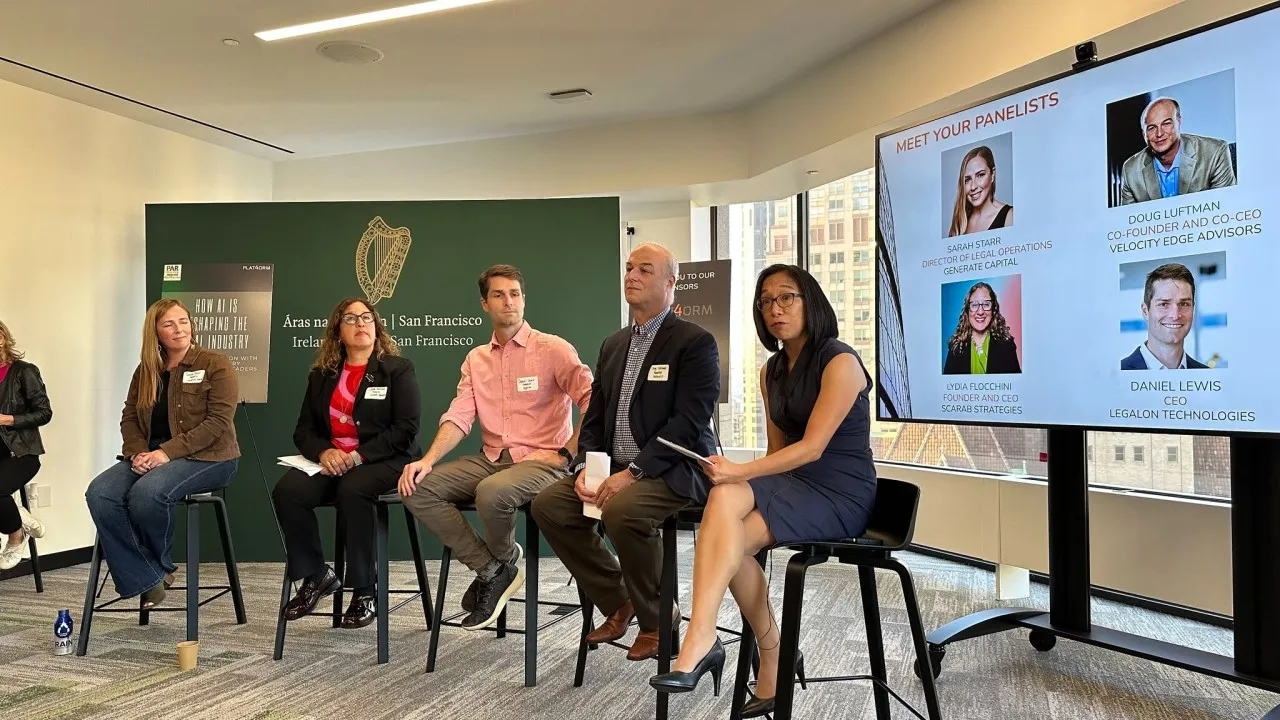
I’ve gone to several legal industry events over the last few months. One theme kept resurfacing regardless of the panel or topic: change management. It happened repeatedly at LegalTech Talk London a few months ago. People came to talk about AI, models, tools and infrastructure investment. With ILTACON coming up next week, I’ll be listening for whether the same theme surfaces there.
The conversation came back to something more basic: How do you actually get an organization to change the way that it works?
The data suggests that this isn’t just a legal industry issue.
It’s reported that 88% of organizations now use AI in at least one business function. But McKinsey identifies only about 6% as AI high performers within organizations generating significant value from AI and attributing more than 5% of EBIT to it.
The technology is nearly universal. The results are not. So, what separates the 6% from everyone else?
One answer stands out. Successful adopters are redesigning the work. McKinsey found that AI high performers are nearly three times as likely as their peers to have fundamentally redesigned individual workflows. Not simply added AI to an existing process, butredesigned the process itself. That distinction is important.
We’ve spent a lot of time talking about AI adoption as if the goal is to get everybody onto the technology. Buy the licenses. Train people on prompting. Put Copilot on the desktop. Track utilization. Those things matter. But they don’t necessarily change the business.
The harder question is: What should the work look like now that AI exists?
The hardest part of building AI capability in an organization is the culture shift, and that shift takes hold only when you reimagine the structures of daily work: what gets measured, who is involved in what training, what gets rewarded, and where leaders invest their attention. In fact, IBM redesigned its performance management process to assess AI skills and behaviors alongside business outcomes. And this type of signal to employees was a fundamental change to what actually gets you recognized and rewarded. That’s what real organizational change looks like.
AI is forcing organizations to reconsider things that are much harder to change than software: workflows, responsibilities, skills, incentives, training, accountability and even how performance gets measured. That may explain why adoption and transformation are starting to look like two very different things.
If AI can create the first draft in minutes, what should the person who used to spend three hours drafting do with that time? If AI can review large volumes of information quickly, where does human judgment become more valuable? If five steps in a process exist because people historically had to move information manually from one place to another, do you still need all five?
A 2026 survey from WRITER’s 2026 “AI Adoption in the Enterprise” survey found that 79% of organizations are still struggling with AI adoption, even though 59% are investing more than $1 million annually in AI technology. And 54% of C-suite executives went so far as to say AI adoption is “tearing their company apart.” That is a pretty remarkable disconnect.
Companies are spending heavily on the technology while still figuring out what needs to change around it. You can make an inefficient process faster and still have an inefficient process. You can give everyone an AI tool and still have very little idea how it should change the organization.
For leadership, the investment imperative right now is clear: make change fitness a core capability, not an afterthought. Invest in broad AI literacy, redesign workflows rather than just jobs, provide training to sharpen skills, and reward learning speed and outcomes.
The ROI gap will keep widening for companies that treat AI as a software rollout. The key is to invest in the human infrastructure around it — the culture, capability building, workflow redesign, and leadership alignment that turn a technology investment into a business outcome.
Ask the harder questions: What work should disappear? What should be automated? Where does human expertise become more valuable? What new skills do people need? What should managers measure differently?
That work is unglamorous. It’s slower than a tool deployment. And right now, it’s the most important thing most organizations aren’t doing. That is the human side of AI transformation. And I think it is about to become even more important.
Which raises the next question: What happens when AI doesn’t just help with the work but starts participating in it? More on that in PART II.





 AI Makes the Breach More Complex. The Fundamentals Still Hold.September 18, 2026
 “Human in the Loop” Isn’t an AI Governance ModelSeptember 14, 2026